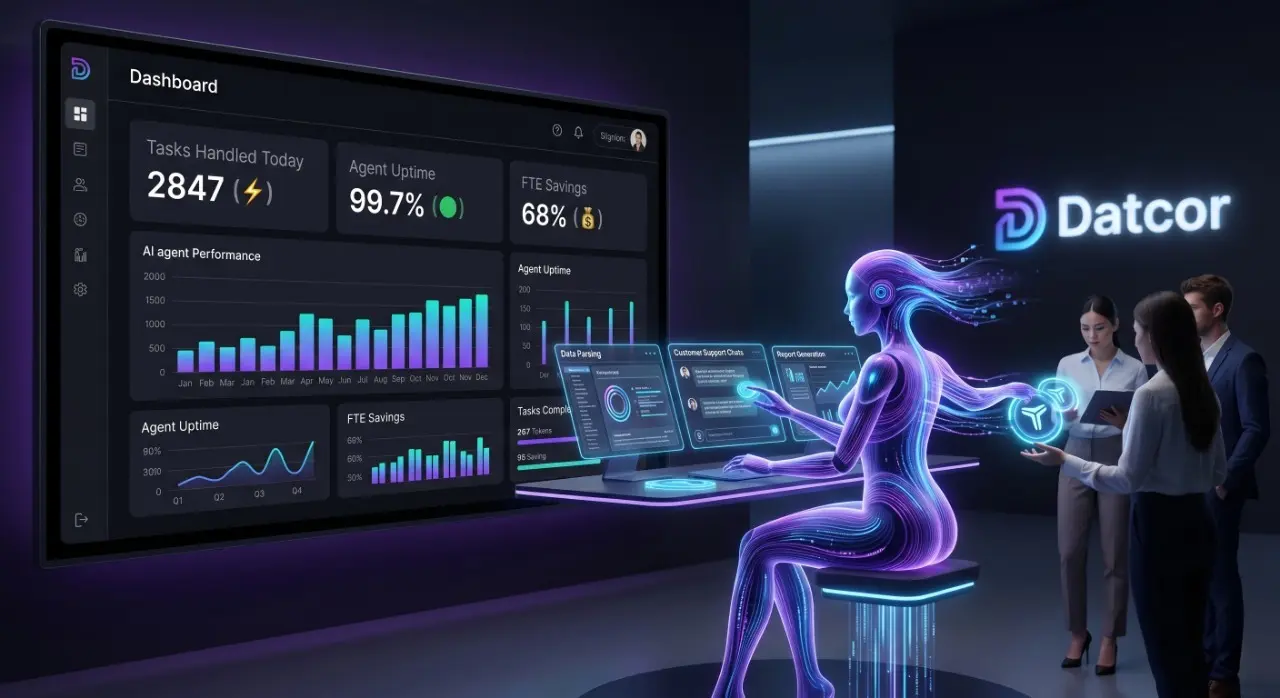
The modern business landscape is evolving rapidly: the focus is shifting from simply increasing the number of employees to effectively optimizing routine processes. Many companies still rely on outdated methods, where a significant portion of a manager’s time is spent on operational routine. However, AI Agents for Business can automate these tasks, freeing up valuable time for strategic growth. Now is the critical moment to consider implementing autonomous agents, as this is the most effective way to invest in operational efficiency (with a potential ROI of ~0.8x per agent).
What are AI Agents for Business and Why Aren’t They Just “Chatbots”?
Most of us are familiar with chatbots — essentially advanced versions of auto-responders that follow a rigid script. However, AI Agents for Business represent a completely different class of software based on large language models (LLMs) such as GPT-4o or Claude 3.5.
Unlike a bot, which simply responds to a query, an autonomous agent can:
- Independently manage a dialogue to achieve a specific business goal without constant human intervention.
- Sense and react to changes in the business process in real-time, adjusting its behavior based on the context.
- Interact with existing IT infrastructure (CRM, ERP, various SQL databases) via API to fetch or push data.
While a chatbot just answers a question, a “Skill-based” agent can perform a complex sequence of actions: qualify a lead, check a manager’s calendar, schedule a meeting, and create a detailed deal in AmoCRM or Salesforce. This transition from “answering” to “doing” is what makes AI agents a game-changer for operational scaling.
5 Effective Ways to Deploy AI Agents for Business
To truly scale, you need to identify where the agent adds the most value. Here are the most common high-impact use cases:
- Lead Qualification: Automatically engaging with new leads, asking qualifying questions, and filtering out non-ideal prospects.
- Customer Support Automation: Handling L1 and L2 support tickets by accessing the company’s knowledge base and solving issues autonomously.
- Data Entry and Sync: Moving data between different platforms (e.g., from a lead form to a CRM) without manual copying.
- Meeting Coordination: Managing schedules across different time zones and booking appointments without back-and-forth emails.
- Internal Process Management: Helping employees find information, generate reports, or trigger internal workflows.
How to Implement AI Agents for Business Effectively?
Implementing professional software solutions always follows a “step-by-step” approach. To avoid costly mistakes, it’s worth sticking to this sequence:
- Analyze the current business process. Determine which routine tasks consume the most time and are the most repetitive. The agent should be designed to solve a specific, measurable problem. Identifying the bottleneck is the first step toward a real result.
- Develop a conceptual framework. At this stage, you don’t need to dive into the technical details of the code. The goal is to define the logical flow of the agent’s actions (a “blueprint”). Once this stage is completed, you can proceed to technical implementation.
- Build and scale. Start with a small set of scenarios (a Minimum Viable Agent) to verify the hypothesis and then scale it to other areas of the company.
Related Reading: Explore how these technologies integrate into a broader strategy in our guide on AI Agents for Business, learn about automating client interactions in AI Agents for Customer Support and Sales.