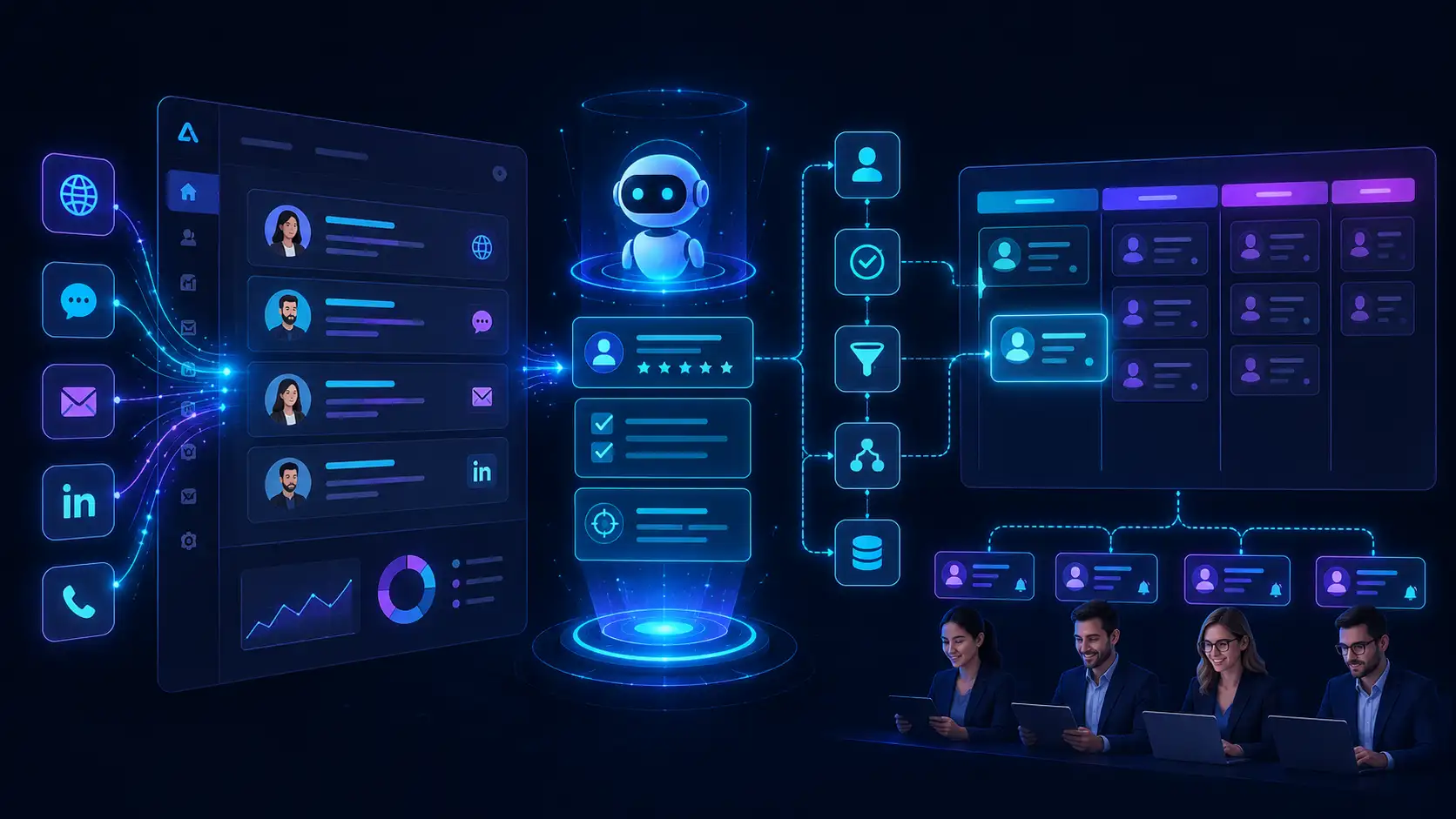
AI for lead generation — it is no longer just a modern trend, but a strategic necessity for any business looking to scale. A fully automated initial contact pipeline allows you to convert more leads by engaging them when their intent is highest, ensuring that every single lead is handled instantly, without the risk of manual errors or delayed responses.
In today’s competitive landscape, the speed of response is everything. Effective AI lead generation allows you to handle the first touchpoint 24/7, ensuring that no potential customer is left waiting, regardless of time zones or staff availability.
Building a High-Conversion Initial Contact Pipeline
Most businesses fail in lead generation not because of poor traffic, but because of a broken conversion funnel. A truly effective pipeline is built on automation: instant lead capture, immediate qualification, automatic CRM entry, and a personalized outreach sequence. This ensures that no lead is lost in the shuffle and every contact is handled with surgical precision.
- Capture leads from multiple channels simultaneously;
- Qualify leads instantly using AI-driven logic;
- Automatically sync data to your CRM without manual entry;
- Ensure zero-gap response times for maximum conversion;
- Drive higher quality leads into your sales funnel.
Ultimately, the goal is to move leads through the funnel as efficiently as possible. For those looking to build a high-volume machine, exploring B2B lead generation AI with web scraping can provide the necessary scale. For a direct implementation, the fastest way to scale your customer acquisition is through a proven automation solution.
Why You Need AI for Lead Generation
AI for lead generation is not about replacing humans, but augmenting them. By automating the tedious parts of the process, you free up your team to focus on high-value closing activities rather than chasing dead ends. A robust AI system provides:
- Instant engagement 24/7: Never miss a lead again;
- Precise qualification: Stop wasting time on unqualified prospects;
- Automated CRM integration: Keep your pipeline clean and updated;
- Consistent follow-ups: No lead is forgotten;
- Scalable outreach: Handle thousands of leads without adding headcount;
- Automated follow-up sequences: Keep prospects engaged until they are ready to buy.
The reality is that AI lead generation is now a requirement for any business that wants to remain competitive. If you are not automating your first touch, you are leaving money on the table for someone who is. For a deeper dive into the fundamentals, you can explore the core concepts of lead generation.
Automation Scenarios for Initial Contact
A typical automation scenario works like this:
- The client leaves a request on the site, writes in Telegram, Instagram, or another channel.
- The system immediately records the source, the text of the request, and the contact details.
- AI analyzes the query: what exactly is needed, how targeted the lead is, and whether there are signs of urgency.
- The client automatically receives the first response with a clarification or confirmation.
- The CRM creates a lead card, sets a tag, status, and assigns a responsible manager.
- The manager receives a structured request instead of a raw message.
This works exceptionally well in combination with CRM and Telegram integration, where inquiries move from the messenger into the sales process without losing context.
What AI Tasks Should Be Automated First
The best effect comes not from trying to automate everything at once, but from a correct start with repeatable points:
- First Response. The client gets an immediate reaction instead of waiting for someone to become available.
- Basic Data Collection. AI clarifies the service, task volume, deadline, niche, or desired cooperation format.
- Lead Qualification. The system distinguishes a relevant business request from general interest or spam.
- CRM Transfer. All responses and contacts are immediately recorded in the system.
- Team Distribution. The lead goes to the manager or department that can actually close it.
If you are scaling sales, it’s also useful to look at CRM automation to accelerate sales — it shows how AI scenarios align with team processes.
| Stage | Manual Processing | AI Automation |
|---|---|---|
| First Response | Delay from a few minutes to hours | Instant reaction 24/7 |
| Data Collection | Manager clarifies everything manually | AI collects a basic brief according to the scenario |
| Qualification | Depends on manager’s attentiveness | Rules and AI models filter out non-target inquiries |
| CRM Transfer | Risk of forgetting or not entering everything | Automatic creation of lead and tags |
| Control | Difficult to see bottlenecks | Full analytics on entry and response speed |
Where AI Lead Generation Gives the Best Results
Most often, AI for lead generation pays off where there is a regular flow of identical or semi-identical inquiries:
- B2B services with incoming requests;
- Marketing and digital agencies;
- Integrators of CRM, ERP, and AI solutions;
- Consulting, where it is important to quickly collect client context;
- Educational products and demo recordings;
- Companies that receive part of their leads via messengers.
If you already have several inquiry channels, AI agents often become the most convenient shell for the initial contact. More details on this can be found in our article about AI agents for small business.
Tools Typically Used
Technical implementation can vary, but most businesses build a combination of several components:
- A form on the site, a chat, or a messenger as an entry channel;
- CRM for saving leads and statuses;
- An AI model for analyzing the request and building a response;
- n8n, Make, or backend logic for routing;
- Analytics for controlling conversion and response speed.
For reference, you can see how similar scenarios are described by Salesforce, HubSpot, and OpenAI. But the main value is not in the tool itself, but in a properly assembled scenario for your funnel.
What’s Important to Consider Before Launch
To prevent automation from creating more noise, you need to answer a few questions before starting:
- Which channels are primary for capturing leads?
- Which fields must be collected at the entry?
- How to distinguish a hot lead from a non-target inquiry?
- Who receives the lead after primary qualification?
- What should the system do if the manager does not respond in time?
In other words, lead generation automation starts not with a prompt for AI, but with normal process logic. First — rules, then — tools.
Common Mistakes When Implementing AI for Lead Generation
- Allowing AI to respond without linkage to CRM and statuses;
- Not collecting a minimum brief before transferring to a manager;
- Not tracking the first response time;
- Mixing all inquiries into one scenario without segmentation;
- Not leaving human control over hot and non-standard leads.
AI should not replace the sales department completely. Its task is to quickly accept an inquiry, bring order at the entry, and reduce losses where manual processing lags.
🎯 AI for lead generation gives the best effect when a business automates not the entire sale at once, but specifically the initial contact: fast response, qualification, transfer to CRM, and follow-up control. This is where losses are most often hidden, which can be eliminated without increasing the team.
If you want to implement AI lead generation systematically, start with one channel and one scenario: for example, requests from the site or Telegram. Once the process becomes stable, it is easy to scale it to other entry points.