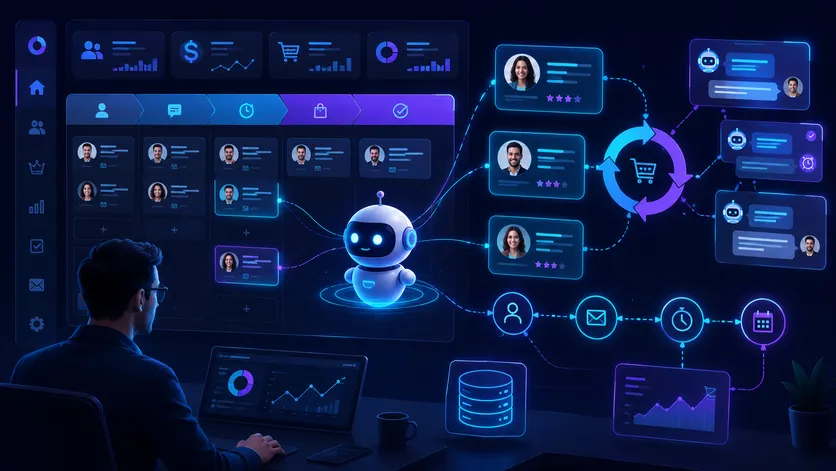
AI agents for repeat sales help businesses avoid waiting for the customer to remember their next order on their own. They analyze purchase history, behavior, CRM statuses, and previous dialogues, then suggest who to contact, when, and with what offer.
The problem with repeat sales is rarely that the team doesn’t want to work with existing clients. More often, it’s simpler: managers are busy with new leads, reminders are scattered across CRMs, messengers, and spreadsheets, and the perfect moment for repeat contact passes unnoticed. As a result, a business already has a client base but continues to spend a budget as if every sale must start from scratch.
An AI agent doesn’t replace a manager in complex communication. Its strength lies in finding the signal in time, preparing the context, and triggering the right action: a message, a task, a segment, a scenario, or a recommendation for the next step.
What are AI Agents for Repeat Sales?
AI agents for repeat sales are automated assistants that work with the customer base after the first purchase: they track repeat order cycles, identify clients at risk of churn, generate personalized offers, and help managers win back customers without manual monitoring.
Unlike a simple calendar reminder, such an agent considers a set of signals: what the client bought, how often they returned, which messages they responded to, which services interested them, and whether there were complaints, payment gaps, or unfinished dialogues.
If a business already has CRM integration with website and messengers, the AI agent can work with the full history of client interaction rather than isolated contacts.
Why Repeat Sales Are Lost Without Automation
In most companies, repeat sales rely on the discipline of the manager. If the manager remembers the client, the contact happens. If not, the client quietly moves to a competitor or simply postpones the purchase.
Most common reasons for losses:
- Lack of a single place for client history — some data is in the CRM, some in Telegram, some in email;
- The manager doesn’t see the moment for repeat contact — for example, a service term expires or a typical repeat purchase cycle passes;
- Identical messages are sent to all clients without considering their previous experience;
- Lack of pause control — a client hasn’t bought in a long time, but no one noticed;
- Repeat sales have no dedicated process and get lost between marketing, sales, and support.
That’s why the automation of repeat sales should start not with mass mailings, but with quality data and clear scenarios. If a client receives a relevant message at the right moment, it’s perceived as care. If not — as spam.
How the AI Agent Knows Who to Contact
The AI agent analyzes events already present in the business systems. These can be purchases, inquiries, payments, completed projects, support requests, opened emails, messenger responses, or status changes in the CRM.
Then the system determines which scenario fits a specific client:
- The client regularly buys every 30 days, but didn’t return this time;
- After the first order, the time for an upsell or cross-sell has passed;
- The client was interested in a service but didn’t proceed to a repeat purchase;
- The product usage or support period has ended;
- The client had a negative experience, so a service contact is needed before a sales pitch.
In this context, AI doesn’t work as a “text generator,” but as an analysis layer over the CRM. It helps identify clients who already have a high probability of returning but need the right trigger.
Typical Scenarios for Repeat Sales
| Scenario | What the AI Agent Tracks | What it Triggers |
|---|---|---|
| Repeat Order | Typical interval between purchases | Reminder to client or task for manager |
| Upsell | Previous purchase, segment, budget | Personalized offer for the next level |
| Dormant Client Recovery | Long pause without purchases or dialogues | Reactivation scenario with a soft excuse |
| Post-sale Follow-up | Purchase date, delivery status or service completion | Satisfaction check and next recommendation |
| Churn Prevention | Complaints, drop in activity, missed payments | Task for manager or service contact |
For service businesses, this could be a reminder for the next appointment. For B2B — a signal that it’s time to renew a package, add an integration, or update a process. For e-commerce — a recommendation for a product that logically complements a previous purchase.
Where AI Agents Outperform Manual Reminders
Manual reminders work as long as there are few clients. But as the base grows, a manager physically cannot remember the context of every client. Even a great team starts acting reactively: responding to those who write first and missing those who could have been brought back earlier.
AI agents provide three practical advantages:
- Scale — the system checks the entire base, not just the manager’s “favorite” clients;
- Context — messages are tied to purchase history, not just a generic date;
- Priority — the manager sees not just a list, but those with the highest probability of a repeat sale.
This complements CRM automation: the CRM stores data and statuses, while the AI agent helps turn that data into specific actions.
What Data is Needed for Launch?
For AI agents for repeat sales to work correctly, they don’t need a perfect “big data” warehouse, but a decent data structure. The minimum is: client, purchase date, product or service, amount, communication channel, and current status.
Useful additional data:
- client correspondence history;
- reasons for refusals or pauses;
- client segment: new, active, VIP, dormant, at-risk;
- purchase frequency and average check;
- previous support requests;
- source of the first contact.
If some of this data is already collected via website, messengers, or forms, there’s no need to move it manually. Just connect the systems. This is often done using CRMs, n8n, Make, email services, spreadsheets, and API integrations.
When data is scattered across channels, the first step is to remove the basic chaos. It’s useful to review the material on why business leads are lost: many of the same reasons hinder repeat sales.
The Process in a Real Business
A practical scenario might look like this:
- The client makes a purchase or completes a collaboration.
- The CRM records the date, product, amount, manager, and communication channel.
- The AI agent analyzes when the next contact is appropriate for this segment.
- The system creates a task for the manager or prepares a personalized message.
- If the client responds, the dialogue returns to the manager with a short context summary.
- If there is no response, a soft follow-up or status change is triggered.
In a service business, this could be a “time to book again” reminder. In B2B services — “60 days have passed since launch, it’s time to offer optimization.” In e-commerce — “the client bought a consumable product, the typical repeat purchase cycle is almost over.”
How This Differs from Email Newsletters
Email newsletters usually work with segments: one campaign is sent to all clients of a certain group. An AI agent works more precisely: it can identify individual events, create personalized reasons for contact, and involve a manager where human communication is required.
For example, an automatic email campaign might remind all clients about a promotion. An AI agent can see that a specific client bought a certain service, hasn’t returned in a while, but previously responded positively to consultations. For them, a personalized message checking if everything is working normally is more appropriate than a promo.
Therefore, AI agents don’t replace email marketing automation. They make it more accurate and prevent repeat sales from becoming just mass emails.
Which Metrics to Track
Repeat sales should be evaluated by business results, not by the number of messages sent. Otherwise, the team will quickly turn the AI agent into another source of noise.
Core metrics:
- Repeat Purchase Rate — the percentage of clients who bought again;
- Time to repeat purchase — how many days pass between orders;
- Revenue from returning clients — tracked separately from new sales;
- Reactivation percentage — how many dormant clients returned after a scenario;
- Follow-up conversion — how many reminders led to a response or purchase;
- Share of manual actions — how much of the managers’ workload was removed.
HubSpot’s la la la l’article on customer retention metrics specifically highlights repeat purchases, churn, lifetime value, and time between purchases as basic retention indicators. For an AI agent, this is a great foundation: its goal is not just to write to clients, but to improve specific retention metrics.
In the HubSpot article on repeat customers, the role of fast reaction and high-quality service in repeat purchases is also emphasized. This is crucial: automation should not make communication colder; its job is to help the team be timely and relevant.
Where AI Agents Can Do Harm
AI agents for repeat sales should not be launched as uncontrolled auto-spam. If the system writes to everyone indiscriminately, ignores the client’s history, or sends an offer immediately after a problematic experience, it doesn’t win back clients — it destroys trust.
Typical mistakes:
- sending identical messages to all segments;
- not checking if the client is already communicating with a manager;
- ignoring complaints, returns, or negative status;
- not limiting contact frequency;
- not allowing the manager to review important messages before sending;
- evaluating effectiveness only by the number of sends.
Salesforce’ la la la l’article State of the Connected Customer report shows that clients expect personalized and connected interactions with companies. This directly applies to repeat sales: a client doesn’t want to explain who they are and what they already bought every time.
How to Start Implementation
The best start is not a complex AI system for every possible case, but one clear scenario with a monetary effect. For example: returning clients who haven’t bought in 60 days; reminders for repeat orders; follow-ups after service completion; upsells for clients with a specific product.
The launch sequence can be:
- Choose one repeat sale process that currently relies on manual actions.
- Verify that the necessary data exists in the CRM, spreadsheets, messengers, or payment systems.
- Describe client segments and the rules for when to contact them.
- Set up integrations between the CRM, communication channels, and the AI agent.
- Launch the scenario initially with manager approval, not full autopilot.
- After 2-4 weeks, evaluate repeat purchases, responses, refusals, and message quality.
If the first scenario shows an effect, the system can be expanded: add new segments, channels, personalized offers, churn risk analysis, and automatic tasks for managers.
Who Is This For?
AI agents for repeat sales are most useful where there is already a client base and a repeatable interaction cycle. These could be service companies, B2 B services, e-commerce, educational projects, subscriptions, local businesses, consulting, technical support, or companies with regular service updates.
If a business sells once and has no logical repeat contact, a retention AI agent might not be the first priority. In that case, it’s better to start with basic customer onboarding automation or by tidying up the CRM.
What to Remember
Repeat sales grow not because the business “reminds itself” more often, but because the contact becomes timely. An AI agent helps find the moment, prepare the context, and prevents the client base from lying dormant.
📌 AI agents for repeat sales provide the greatest effect when they work not as mass mailing, but as a system of precise actions: they see the client’s history, understand the moment for contact, suggest the next step to the manager, and help win back customers without manual tracking of every date.
FAQ
Can an AI agent write to clients on its own?
Yes, but it’s better to start with a mode where important messages are first approved by a manager. Full autopilot is appropriate only for simple and well-verified scenarios.
What is needed to launch AI agents for repeat sales?
You need a client base, purchase or interaction history, clear segments, and communication channels. Most often, this is a CRM, messengers, email, payment systems, or spreadsheets.
Why is an AI agent better than regular CRM reminders?
A regular reminder works by date. An AI agent can consider context: client behavior, previous purchases, responses, churn risk, segment, and the probability of a repeat sale.
Is this too complex for a small business?
No, if you start with one scenario. For example, automatically finding clients who haven’t bought in a long time and creating a task for the manager with a ready-made context for the message.