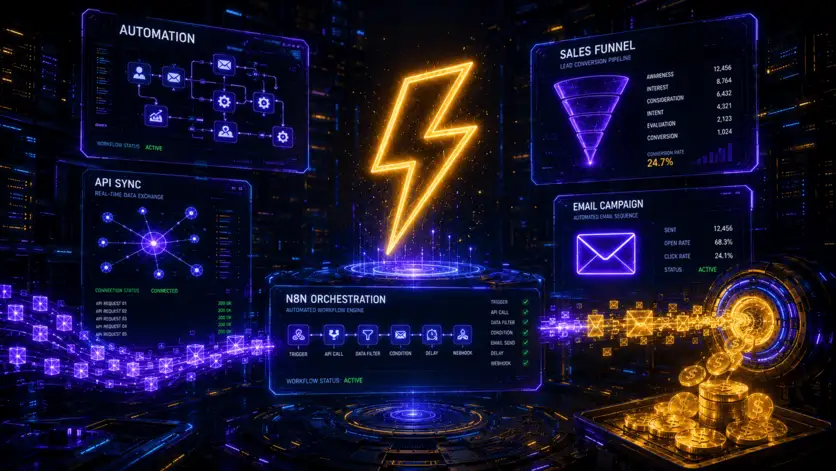
In today’s digital business, email marketing automation has long ceased to be a tool for mass, ‘blind’ mailings. Sending the same letters to the entire contact base is a direct path to audience burnout, domain rating drops, and landing in spam filters. Today, email marketing is a complex, data-driven ecosystem operating on triggers, deep personalization, and seamless information exchange between servers.
A correctly designed and configured email marketing automation sales funnel can become your most effective salesperson, generating revenue 24/7, minimizing the human factor, and radically maximizing ROI. In this detailed guide, we will break down the architecture of the ideal email funnel, lead scoring methods, and the technical tools that allow you to implement all this without critical dependence on expensive proprietary SaaS platforms.
Why Obsolete Email Marketing Automation Burns Your Budgets?
Most companies still use the email channel as a digital postcard, ignoring context. They fail to consider which stage of the decision cycle the client is in, which pages they have visited, and which pain points they are trying to solve.
Key problems of the classic approach:
- Low Open Rate: Due to irrelevant subject lines.
- High Bounce Rate: Due to lack of base validation at the collection stage.
- Lack of Segmentation: Sending ‘B2B Enterprise’ solutions to small clients, or vice versa.
To break this vicious cycle, deep analytics integration is required. This is where AI agents for data processing come to the rescue. They are capable of analyzing user behavior patterns in real-time, segmenting the base by dozens of criteria, and forming the most relevant triggers for launching mailings.
Architecture of the Ideal Sales Funnel: Detailed Breakdown
Creating an effective email funnel is like programming: a IF-THEN-ELSE logic is constructed. Let’s consider five fundamental stages of a high-conversion funnel.
1. Lead Capture and Validation
Any funnel begins with filling. But quantity does not mean quality. For the system to operate stably, you need reliable lead generation automation.
- Mechanics: The user leaves an email in exchange for a lead magnet (e.g., a technical whitepaper).
- Technical Process: Instead of writing directly to the database, a Webhook passes the data to an orchestration system (e.g., n8n), where address validation occurs (syntax check, MX records, and blacklist check) via third-party APIs. Only clean contacts enter the CRM.
2. Welcome Sequence (Onboarding and Activation)
After subscription confirmation (Double Opt-in), the system immediately launches a series of introductory letters.
- Letter 1 (Immediate): Delivery of the promised lead magnet + a short greeting.
- Letter 2 (After 24 hours): A story about the company’s mission and key expert materials.
- Letter 3 (After 48 hours): Highlighting typical customer pain points and hinting at how your product solves them.
The goal of this stage is not to sell aggressively, but to train the user to open your letters and see value in them.
3. Lead Nurturing and Dynamic Scoring
This is the most complex and important stage of email marketing automation. The system begins tracking user interaction with content. A mathematical evaluation model — lead scoring — is applied here.
- Opened a letter:
+2 points - Clicked a link to a case study:
+5 points - Visited the ‘Pricing’ page on the site (tracked via tracking pixel):
+15 points
When the total score reaches a set threshold (e.g., 50), the system identifies the lead as ‘hot’ (SQL — Sales Qualified Lead) and automatically changes their status in the funnel.
4. Conversion Stage (Bottom of the Funnel)
For ‘hot’ leads, a separate trigger branch for email marketing automation is launched.
- If it’s e-commerce: a letter with a dynamic discount for an abandoned cart is sent.
- If it’s B2B/SaaS: a personalized letter on behalf of a manager with a proposal to schedule a demo call is sent.
Integration is critical here: if a client replies to such a letter, the response must be immediately recorded in the CRM.
5. Retention, Upsell, and Cross-sell
A sale is not the end of the funnel, but the beginning of a long-term relationship.
- Post-sale: Automatic letters with product usage instructions, request for feedback (NPS survey).
- Reactivation: If a client does not open letters for more than 60 days, a special campaign with an ‘irresistible’ offer is launched. If there is no reaction, the contact is removed from the base to avoid damaging domain statistics.
Technical Stack: Why n8n Wins Over Classic SaaS Solutions?
Most companies start by using platforms like HubSpot, Mailchimp, or GetResponse. But as the subscriber base grows and the logic becomes more complex, the pricing of these services becomes unjustifiably high, and the functionality — insufficiently flexible.
The solution for modern business is transitioning to business process automation on n8n. This is a powerful orchestration tool that allows building workflows of any complexity.
Advantages of n8n-based architecture:
- Self-hosting and Security: You can deploy n8n on your own server. Your clients’ data never leaves your perimeter, which is critical for companies working under GDPR or HIPAA standards.
- Absolute Limitlessness: In classic SaaS, you pay for every contact in the base or for the number of ‘steps’ in automation. In n8n, you are limited by nothing. Using a third-party SMTP server (e.g., Amazon SES, SendGrid, or Mailgun), the cost of sending 10,000 letters is just a few cents.
- Unlimited Integrations: n8n supports thousands of apps. You can link your site (WordPress, Webflow), CRM (Pipedrive, Amo, Salesforce), messengers (Telegram, Slack), and email services into a single monolithic mechanism.
- Complex Logic: You can create branches (If/Else Switch), loops, work with databases (PostgreSQL, MongoDB), and custom HTTP requests directly in the visual editor.
CRM and AI Integration: Creating a ‘Smart’ Ecosystem
The magic of automation begins when different systems communicate seamlessly. A reliable CRM and AI integration via API is the heart of your funnel.
How it works in practice:
When n8n records that a client has reached ‘hot’ lead status (scored 50 points), it makes an API call to your CRM. The system automatically creates a Deal, assigns a responsible manager, pulls the entire history of interaction with letters, and sends a notification to the manager in Telegram or Slack: ‘Attention! Client X just viewed the price list twice. Call them now’.
Moreover, the era of generative AI has changed the rules of engagement with clients. Instead of managers spending time answering standard questions in response to your mailings (e.g., ‘What are your payment methods?’ or ‘Is there delivery to region Y?’), you can implement AI agents for support and sales.
Such agents, connected via API (e.g., OpenAI or Anthropic), read incoming emails, analyze client intent, refer to your internal knowledge base, and automatically form a personalized, polite, and comprehensive response. The manager connects only at the stage of closing the deal or when complex, non-standard requests arise.
Metrics and Analytics: How to Measure Email Marketing Automation Success?
Even the most sophisticated funnel requires constant optimization (A/B testing). For this, dashboards are set up that track in real-time:
- Delivery Rate: How successfully your letters bypass spam filters.
- Open Rate / CTR: Effectiveness of subject lines and the content itself (Call-to-Action).
- Conversion Rate: How many leads from the email channel turn into real money in the register.
- Customer Acquisition Cost (CAC): The cost of acquiring one client through this funnel.
All these data can also be automatically exported to Google Looker Studio using n8n, creating a single center for managerial decision-making for marketers and leadership.
Conclusion: Time to Scale Sales
Creating an automated email funnel is a strategic investment in the foundation of your business. Transitioning from chaotic mailings to a systematized process based on open architecture (n8n), API integrations with CRM, and the power of artificial intelligence allows email marketing automation to generate a predictable flow of sales without constantly expanding staff. This is not just marketing — it is the digital transformation of your sales.
Ready to optimize your processes, reduce SaaS costs, and build a funnel that actually generates profit? Explore how we can implement these technical solutions for you by viewing Datcor products and services, or leave a request for an audit on our homepage.