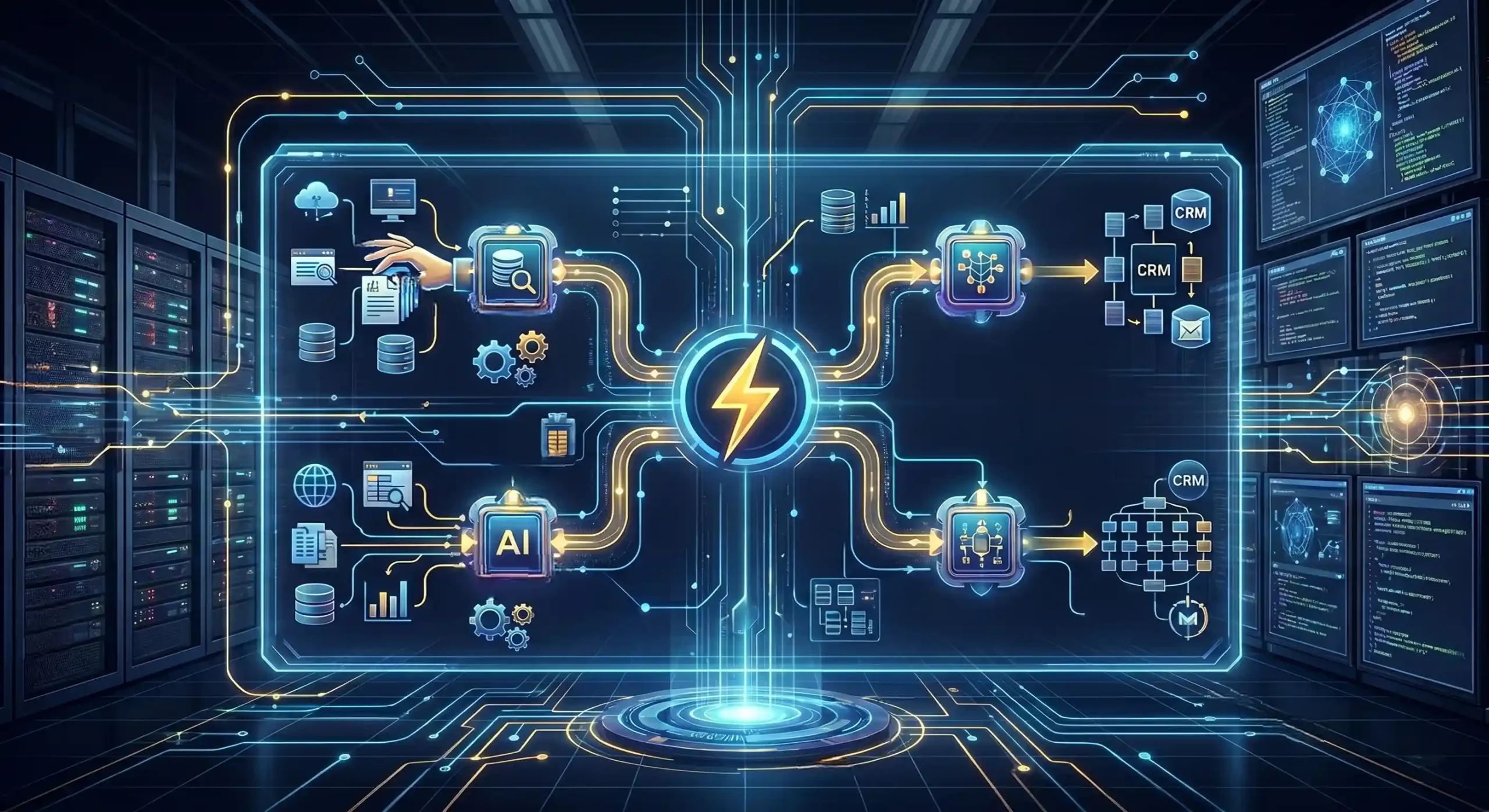
Modern business has already outgrown the stage of simple chatbots capable only of answering basic questions based on a script. Today, isolated solutions are being replaced by Agentic Workflows (multi-agent systems) — an architecture where several specialized artificial intelligences work as a single coordinated team.
Instead of trying to create one “universal AI” that often makes mistakes when performing complex tasks, companies implement an ecosystem of narrow-profile agents. Each has its own area of responsibility and access to specific databases and tools.
From Monolith to Team: How Multi-Agent Architecture Works
Imagine a classic analytics department. It has a specialist who gathers information, an analyst who processes it, and a manager who makes the final decision. Agentic Workflows replicate this structure in a digital environment.
A typical multi-agent chain looks like this:
- Researcher Agent: Gathers raw data from open sources, websites, or internal databases.
- Analyst Agent: Structures the gathered information, cleans it from “noise,” and performs calculations. This is a perfect example of how AI agents for data work operate, ensuring high accuracy in processing large volumes of information.
- Action Agent: Receives ready-to-use data and performs an action — for example, creates a client card in the database or sends a personalized email.
All this interaction happens in milliseconds without human intervention.
Technical Advantages: API, Orchestration, and Self-hosting
For a multi-agent system to work stably, it needs a reliable foundation. The efficiency of Agentic Workflows is based on three technical pillars:
- Deep API Integration: Agents do not exist in a vacuum. They constantly interact with your ERP, email, payment gateways, and other services. Proper CRM and AI integration via API allows agents to independently update deal statuses, enrich lead profiles, and initiate follow-ups.
- Self-hosted Orchestration: To manage a team of agents, a conductor is needed. The optimal solution for the Enterprise sector is business process automation on n8n. Deploying the orchestrator on your own servers (Self-hosting) guarantees no limits on the number of operations and full control over data security.
- Security and Isolation: Each agent receives exactly as many rights and access to data as is needed to perform a specific role. This minimizes the risk of trade secret leaks or critical errors.
What ROI Does Agentic Workflows Implementation Bring?
Investments in multi-agent systems pay off through a drastic reduction in operating costs and the elimination of the “human factor” from routine processes.
- Scaling Without Hiring: You can process 10-100 times more requests, documents, or leads without increasing staff. The system scales simply by allocating additional server capacity.
- Reducing the Cost of Error: Because one agent can verify the work of another (Reviewer Agent), the level of hallucinations and inaccuracies approaches zero.
- Accelerating the Deal Cycle (Time-to-Market): Automated agents can guide a client from the first contact to signing a contract 24/7.
Agentic Workflows are not just a trend; they are a new standard for building corporate IT infrastructure. Moving to multi-agent systems allows a business to delegate not only text generation to AI but also complex decision-making logic and multi-stage task execution.
If you are ready to transform your business processes, escape the limitations of classic automation, and implement solutions that guarantee real ROI, check out our products and services. The Datcor team will help design and deploy a multi-agent architecture that works exclusively for your results.