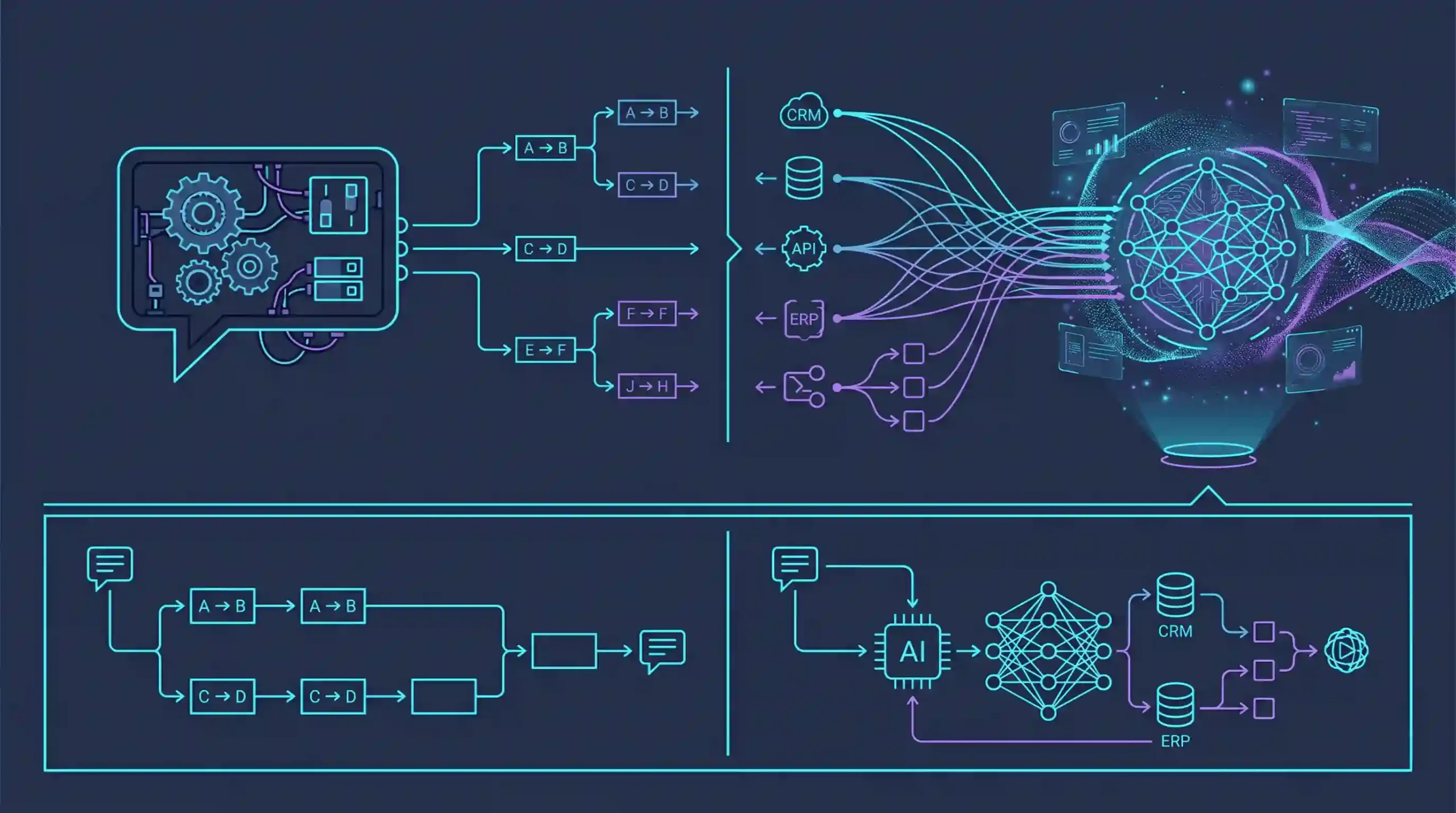
If you are looking for an answer to the question AI agent vs chatbot — this article is for you. We will break down in detail the differences between these two types of solutions, the advantages of each, and how to make the right choice for your business in 2026.
Chatbot: A Quick Solution with Limitations
A chatbot is a program that interacts with the user based on a predefined scenario. The working principle is simple: “if — then.” If the client writes “price” — send a template with the price list. If they write “delivery” — respond about delivery.
This approach works when there are few requests and they are predictable. But as soon as the client phrases the question differently or asks something more complex — the chatbot gets lost.
Advantages of a Chatbot
- ⚡ Fast setup in 1-2 days
- 💰 Low implementation cost
- 📝 Suitable for simple FAQs on a website
- 🔧 Requires no technical expertise
Limitations of a Chatbot
- ❌ No understanding of conversation context
- ❌ Inability to handle non-standard requests
- ❌ Breaks down at the slightest deviation from the script
- ❌ Requires constant manual updates of scenarios
AI Agent: Next-Generation Intelligent Automation
When it comes to AI agent vs chatbot, the difference becomes obvious at the architectural level. An AI agent is built on Large Language Models (LLMs) and is capable not just of responding — it understands, analyzes, and acts.
Unlike a chatbot, an AI agent can:
- 🧠 Process natural language without rigid scenarios
- 🔗 Work with data from CRM, knowledge bases, and spreadsheets
- ⚙️ Perform multi-step tasks autonomously
- 📈 Learn and improve with every interaction
- 🔌 Integrate with any system via API
- 🤖 Independently make decisions instead of a simple “if — then” logic
Comparing AI Agent vs Chatbot: Detailed Table
| Criterion | Chatbot | AI Agent |
|---|---|---|
| Flexibility | Rigid scenario | Adaptive behavior |
| Error Handling | Repeats template | Finds solution independently |
| Integrations | Limited | API, CRM, databases |
| Cost | From 0/month | From 00/month |
| Scalability | Medium | High |
| Implementation Time | 1-2 days | 1-2 weeks |
| Context Understanding | ❌ | ✅ |
| Document Processing | ❌ | ✅ |
When to Choose an AI Agent Instead of a Chatbot
If your business deals with complex customer requests, requires CRM integration for sales department automation, or wants to process leads 24/7 without losing quality — an AI agent will handle these tasks far more effectively.
It is especially important to choose an AI agent if:
- 📊 You have a large flow of similar questions with variations
- 🔗 You need to automatically update data in CRM
- 📁 Clients send documents that need to be analyzed
- 🌐 You operate in multiple channels simultaneously (Telegram, website, email)
- 💬 You need personalized communication based on client history
A Practical Real-Life Example
Imagine a real situation: a client writes in the website chat: “I need a solution for sales department automation, budget up to 00 per month, preferably with integration into our CRM.”
Chatbot: Will wait for the keyword “price”, “services”, or “budget”. If the client phrases it differently — it won’t respond or will suggest something irrelevant.
AI Agent: Will analyze the entire context, recognize the interest in sales automation, ask for clarification on team size, automatically check the availability of the appropriate plan in your database, send a commercial proposal and create a task in CRM for the manager.
As you can see, AI agent vs chatbot — these are not just different tools, but different levels of business capability.
How to Choose the Right Solution for Your Business
Here is a simple checklist to help you decide:
- ✅ If you have up to 50 similar requests per day and a simple scenario — a chatbot is sufficient
- ✅ If requests are complex, varied and require integrations — choose an AI agent
- ✅ If you need to save on routine operations with an ROI of over 300% — an AI agent wins
- ✅ If your budget is limited and you need a quick solution — start with a chatbot
Conclusion
In the confrontation AI agent vs chatbot, there is no single winner — each tool has its place. Chatbots are suitable for simple tasks with clear scenarios. AI agents are for complex automation, where flexibility, integrations, and context understanding are required.
The cost of implementing an AI agent is higher, but thanks to the savings on routine operations, the ROI is recovered in 2-3 months. If you are seriously focused on automation — invest in the right solution from the first time.
Read also: AI Agents for Support and Sales — how one tool replaces three separate systems.