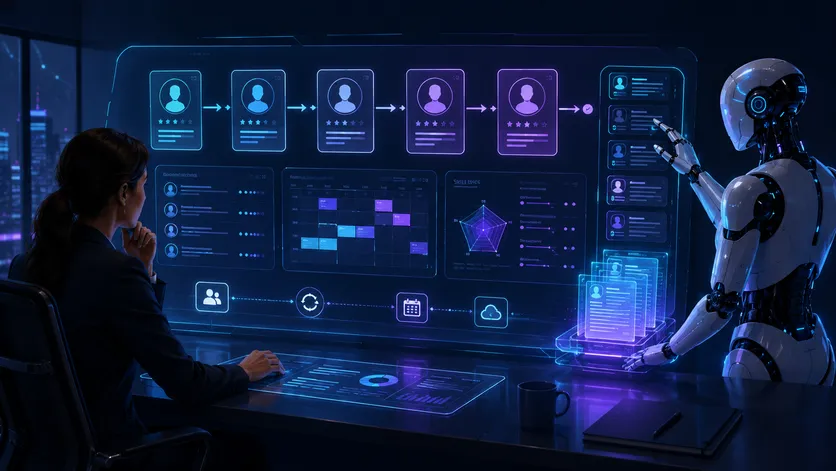
AI agents for HR recruiting in 2026 are no longer just an experiment for large corporations. For small and medium-sized businesses, they are a practical way to process applications faster, avoid losing candidates in messengers, remove routine from recruiters, and see the hiring funnel in numbers.
The problem isn’t that HR teams don’t want to work efficiently. The problem is that hiring often consists of dozens of small actions: reviewing resumes, asking clarifying questions, checking basic criteria, scheduling calls, passing information to a manager, updating a table or ATS. These repetitive steps are exactly what an AI agent can take over.
Important: AI in recruiting should not replace human decision-making. Its powerful role is to prepare information, accelerate initial communication, and help the HR specialist make decisions based on structured data, not chaotic messages.
What are AI Agents for HR Recruiting and How They Work?
An AI agent for HR is a software assistant capable of independently performing part of the recruiting process: analyzing applications, questioning candidates, collecting answers, evaluating fit against basic criteria, creating a brief profile summary, and transferring data to CRM, ATS, Google Sheets, or other systems.
Unlike a standard chatbot, an AI agent doesn’t just follow a rigid script. It understands the context of a candidate’s answer, clarifies details, forms a summary for the recruiter, and triggers the next action in integrations. If for customer support we already discussed the difference in the article AI agent vs chatbot difference for business, then in HR the logic is similar: the bot answers, the agent manages the process.
Where HR Teams Lose the Most Time
In recruiting, a lot of time is spent on operational work rather than strategic talent search. This is especially noticeable when a company hires for several positions at once or receives many irrelevant applications.
- manual review of a large number of resumes;
- repetitive questions about experience, salary expectations, work format, and availability;
- coordinating calls between the candidate, HR, and manager;
- chaotic data storage in Telegram, email, sheets, and notes;
- slow responses to candidates, causing top talent to go to competitors;
- lack of transparent statistics: how many candidates arrived, how many were filtered, and where the funnel is leaking.
A similar problem occurs in sales: if leads come from different channels, managers quickly lose control. We already showed this in the example of AI lead qualification. In recruiting, the mechanics are almost identical, only instead of a lead — a candidate, and instead of a deal — a hire.
Tasks an AI Agent Can Automate in Recruiting
The best results come not from abstract “AI for HR”, but from specific scenarios. When a business understands which part of the hiring process needs acceleration, the AI agent becomes a working tool rather than a toy. Effectively, AI agents for HR recruiting allow companies to scale their hiring without increasing headcount.
Initial Candidate Screening
An AI agent can receive an application from a form, website, LinkedIn, email, or messenger, ask clarifying questions, and build a structured candidate card: experience, skills, expectations, availability, language, work format, relocation, and readiness for a test task.
After this, the recruiter sees not a chaotic chat history, but a concise summary: who the candidate is, how well they fit, what the risks are, and what should be verified during the interview.
Candidate Communication
One of the biggest downsides of manual hiring is slow response time. An AI agent can immediately confirm receipt of the application, ask basic questions, explain the next step, and offer available time slots for a call.
This doesn’t mean the candidate only speaks with a machine. On the contrary, the AI handles the first technical steps so that the HR can step in faster where human evaluation is required.
Preparing a Brief Summary for the Hiring Manager
A manager doesn’t always need to read the full resume and entire chat history. An AI agent can prepare a short profile: relevant experience, strengths, potential doubts, salary expectations, and recommended interview questions.
Updating ATS, CRM or Google Sheets
If recruiting is managed in sheets or a CRM, an AI agent can automatically create records, update statuses, add notes and reminders. Integrations via n8n, Make or API work best for such processes. More about the automation approach can be seen in the article n8n business automation system integration.
AI Agents for HR: What to Automate vs What to Keep Human
| Work Area | What AI Agent Can Do | What Must Remain Human |
|---|---|---|
| Initial Screening | Collect answers, verify basic criteria, structure the profile | Evaluate potential, motivation, and cultural fit |
| Communication | Send confirmations, ask clarifications, schedule calls | Lead complex negotiations and build trust |
| Analytics | Show candidate sources, conversions, stage velocity | Make management decisions on hiring strategy |
| Candidate Evaluation | Compare answers with formal vacancy requirements | Make the final decision on hire or rejection |
| Documents | Prepare email templates, interview summaries, notes | Verify legally important wording and conditions |
Why AI in Recruiting Needs Control
Recruiting is a sensitive area, so AI cannot be implemented on a “set it and forget it” basis. Decisions affect people, careers, and access to jobs, so businesses need transparent rules: what data is collected, how it’s used, who sees the result, and who makes the final decision.
According to the SHRM State of AI in HR 2026, AI in HR is most often applied in recruiting, but organizations need strategy, governance, and effectiveness measurement. This is an important signal: it’s not enough for a business to just add an AI tool; it must be embedded into the process.
In the US, the EEOC reminds that candidate selection tools must comply with anti-discrimination requirements. In the EU, AI systems for employment and selection may fall into the high-risk category under the AI Act. For Ukrainian businesses, this is also important, especially if the company works with international candidates, clients, or markets.
What a Proper AI Agent Architecture for HR Looks Like
A practical scheme can be quite simple. It’s not necessary to build a complex HR platform immediately. Often, it’s enough to build the process around existing channels and systems.
- Candidate Source: Website form, LinkedIn, email, Telegram, job board, or referral.
- AI Agent: Performs initial clarification, collects answers, and forms a profile.
- Database: ATS, CRM, Google Sheets, Airtable, or internal system.
- Integrations: Calendar, messengers, email, task system, analytics.
- HR Control: Recruiter verifies the result, adjusts the status, and makes a decision on the next stage.
If a company already has a CRM or operating system, the HR process can be connected to it. For example, in the article CRM for small business (similar logic), we discussed why it’s important to see client processes in one place. For recruiting, the principle is the same: all candidates, statuses, and next actions must be structured.
When an AI Agent for Recruiting Gives the Greatest Effect
An AI agent works best where there is a repetitive process and clear criteria. If a company hires one person once a year, complex automation may be redundant. But if vacancies open regularly, there are many candidates, and the HR is constantly switching between channels — the effect will be rapid.
- mass hiring in sales, support, logistics, operational roles;
- constant search for IT, marketing, or sales specialists;
- many applications with low relevance;
- candidates write to different channels, and some applications get lost;
- managers wait long for a short list of candidates;
- lack of clear analytics on the hiring funnel.
In such scenarios, AI agents for HR recruiting can reduce the load on HR, accelerate the first response, and make hiring more manageable.
Step-by-Step Implementation Plan
It’s best to start not with “let’s implement AI in HR”, but with one narrow scenario. This makes it easier to measure the result and avoid creating chaos in the process.
- Describe the current hiring funnel. Where candidates come from, who responds, where data is stored, what statuses are used.
- Choose one process for automation. For example, initial screening or scheduling calls.
- Create evaluation criteria. Which answers are mandatory, which factors are critical, which questions cannot be delegated to AI.
- Connect channels and database. Form, email, messenger, table, CRM or ATS.
- Add human-in-the-loop. AI prepares a recommendation, but the HR confirms the decision.
- Measure the result. First response time, number of processed candidates, conversion to interview, quality of the shortlist.
As with any automation, it’s important to count not only the time saved but also the quality of the process. We wrote about this in detail in the material automation business cost: a good implementation should pay off through less manual work, faster decisions, and fewer errors.
Typical Mistakes When Implementing AI in HR
- Fully delegating selection to AI. This is risky both in terms of quality and ethics.
- Not explaining the process to candidates. A person should understand that part of the communication is automated.
- Collecting excessive data. The HR process should work only with information truly needed for the vacancy.
- Not testing scenarios. An AI agent needs to be checked on real examples of responses, not just on ideal cases.
- Not measuring the result. Without metrics, it’s hard to understand if automation actually helped.
FAQ: AI Agents for HR and Recruiting
Can an AI agent hire people independently?
Technically, AI can automate many stages, but the final decision on hiring must remain with a human. An AI agent should help the HR team, not replace professional candidate evaluation.
Is AI recruiting suitable for small businesses?
Yes, if there is regular hiring or a lot of repetitive communication with candidates. A small business doesn’t necessarily need to buy a complex HR system: often, an integration of a form, messenger, calendar, and table is enough.
What should be automated first?
Most often, it’s worth starting with initial candidate screening and scheduling calls. This quickly gives a tangible result by removing a lot of manual communication.
Are there risks of discrimination when using AI in recruiting?
Yes, if AI is used without control, transparent criteria, and result verification. Therefore, it’s important to keep a human in the process, document selection rules, and not use opaque assessments as the sole basis for a decision.
📌 AI agents for HR work best not as a “robot recruiter”, but as an operational assistant: quickly collecting data, structuring candidates, updating systems, and giving the HR team more time for human evaluation, communication, and strong decisions.
If recruiting in your company is already growing into dozens of manual actions, Datcor can design an AI agent for your process: from initial candidate screening to integration with CRM, ATS, Google Sheets, calendar, and messengers.