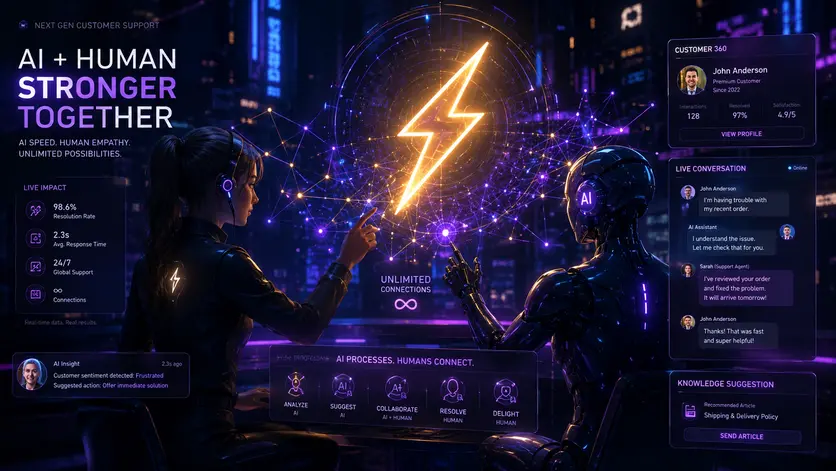
In today’s digital world, the speed of a business’s response to a customer’s request has become a key factor of competitiveness. Users are no longer willing to wait hours for an answer, let alone days. When the number of inquiries grows, the team’s pain becomes critical: employee burnout, falling SLA (Service Level Agreement) metrics, and a decrease in the overall customer satisfaction level (CSAT). In such conditions, scaling through simply hiring new operators turns into an inefficient waste of budget.
The solution is a deep, architecturally thoughtful customer support automation. Delegating routine processes (L1 and partially L2 requests) to artificial intelligence allows not only to free up specialists’ time for solving complex tasks but also to build a fault-tolerant system that works 24/7 without loss of quality.
Anatomy of the Problem: Why Traditional Support and Poor Customer Support Automation No Longer Work?
Scaling a business inevitably leads to an increase in communication load. Companies that rely exclusively on manual ticket processing sooner or later face the ‘bottleneck’ effect.
1. Burnout and Staff Turnover
Up to 80% of support operator’s working time is spent answering the same questions: ‘Where is my order?’, ‘How do I reset my password?’, ‘What are the return conditions?’. This monotonous work quickly leads to burnout, which increases staff turnover. Business is forced to constantly invest in searching for and training new employees.
2. Operational Chaos and Data Loss
When communication is conducted through scattered channels (Telegram, WhatsApp, email, site chat) without a la single routing system, operational chaos in small business and even medium corporations arises. Operators make mistakes when manually transferring data to the CRM, duplicate dialogues, or completely lose leads in the flow of messages.
3. Financial Losses from Slow Response
During off-hours, weekends, or peak loads (for example, during sale periods), the response time grows critically. Every hour of waiting reduces the probability of a repeat purchase or a successful upsell.
Evolution of Solutions: From Rigid Scripts to Intelligent Customer Support Automation
Many companies tried to solve the workload problem using linear chatbots. However, such solutions often only irritate customers, creating endless labyrinths of buttons. To understand the real potential of modern technologies, it is worth studying the key differences between an AI agent and a chatbot.
Modern AI does not simply follow a pre-written decision tree. It is based on large language models (LLMs) and RAG (Retrieval-Augmented Generation) technology. This means that the agent:
- Understands natural language and the complex context of the dialogue.
- Accesses the company’s internal knowledge base in real-time.
- Is capable of identifying the user’s intent and independently solving the problem by calling the required API.
Implementing AI agents for support and sales guarantees a transition from reactive to proactive service. Thanks to the concept of Agentic workflows, AI agents can perform multi-stage tasks: for example, accept a complaint about a damaged product, request a photo, analyze it, create a refund request in the ERP system, and send the customer a tracking number for the return shipment. And all this — without any human intervention.
Deep Technical Integration: How Customer Support Automation Works Under the Hood?
Real resource savings begin where manual data management ends. For AI support to be effective, it must be deeply integrated into the company’s IT infrastructure. According to Zendesk’s industry benchmarks, the move to an integrated AI support model can reduce the average handle time (AHT) by up to 30%.
The Role of n8n in Data Routing
To build a fault-tolerant system, we at Datcor use powerful automation platforms. Using n8n allows creating complex logical chains and managing data flows. When a message arrives in a messenger, a webhook instantly passes it to n8n, which, in turn, launches the AI agent, passing it the history of the client’s previous interactions.
Seamless CRM and AI Integration via API
A key success factor is the correct CRM and AI integration via API. What this gives in practice:
- Customer Identification: The AI agent automatically checks the phone number or email against the CRM database.
- Personalization: The agent ‘knows’ the purchase history, current subscriptions, or active tickets of the client, addressing them by name and offering relevant solutions.
- Logging: The entire communication history is automatically saved in the customer’s card.
- Escalation (Handover): If the request is too complex, the AI instantly transfers the dialogue to a live operator, attaching a concise summary of the previous conversation, so that the person doesn’t have to reread the whole chat.
Self-hosting and Data Security
For the enterprise segment and companies working with confidential information (finance, medicine), security is critical. The ability to deploy such systems on their own servers (Self-hosting) guarantees that no customer data enters open cloud environments. For more details on data protection standards, refer to the GDPR guidelines on Wikipedia.
Real Business Impact: ROI, Metrics, and Resource Savings
Implementing AI support is not just a technological innovation; it is a strategic business decision with clear mathematical justification.
Here is how automation affects the company’s economics:
- Drastic Reduction of Cost Per Ticket (CPT): Processing a single inquiry by a live operator can cost a company from to 0 (depending on the niche). An AI agent reduces this cost to a few cents per API request.
- Payroll Optimization: Instead of hiring 10 L1 operators to work in three shifts, a business only needs 2-3 highly qualified L2/L3 managers who will handle only those 20% of requests that the AI could not manage.
- Limitlessness and Resilience to Load: During promotion periods (Black Friday, New Year’s holidays), an AI agent can process 10, 100, or 10,000 dialogues in parallel and without delays. No human team is capable of this.
- Improving Service Quality: Thanks to instant (up to 5 seconds) responses 24/7, companies record a significant increase in customer loyalty metrics (NPS and CSAT).
Practical Steps to Implementing Automation
Transitioning to intelligent support requires a systematic approach. We recommend the following algorithm:
- Process Audit: Identification of the most popular L1 requests that take the most time from the team.
- Digitizing the Knowledge Base: Creating clear regulations, FAQs, and documentation on which the model (RAG) will be trained.
- Architecture Development: Choosing integration platforms (n8n), setting up APIs and webhooks, connecting CRM.
- Testing and Tuning: Launching the AI agent in an isolated environment or for a limited group of users to calibrate prompts and behavior.
- Deployment and Analytics: Full launch with subsequent efficiency monitoring and regular updating of the knowledge base.
Conclusion
To reduce the workload on the team, get rid of operational chaos and turn customer support from a cost center into a driver of loyalty and repeat sales, a business must invest in intelligent customer support automation. Modern AI agents, integrated via reliable API gateways and systems like n8n, are the new standard of technical and customer support, saving resources and guaranteeing flawless service 24/7.
Ready to optimize your business processes, scale without inflating staff, and implement advanced AI solutions in your company? Learn more about collaboration opportunities, our cases, and technologies on the Datcor homepage and start the transformation of your support today!