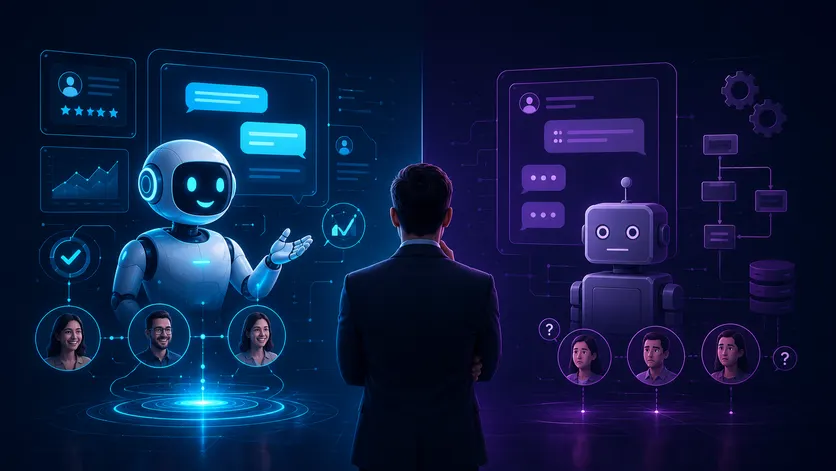
Chatbots vs AI agents for support — which is faster, more efficient, and more profitable for your business in 2026? For many companies, this question is now the starting point for choosing a customer service system. Modern support is no longer just about a feedback form, a phone number, or a “Write to us” button. Customers expect businesses to respond quickly, clearly, and concisely, regardless of whether they reach out via a website, Telegram, Instagram, or email. This is why companies are increasingly automating their support. But a practical question arises: should you choose a classic chatbot or AI agents for support?
At first glance, the difference seems minor. Both chatbots and AI solutions answer customers, help with navigation, and reduce the workload on managers. If you want to dive deeper into the fundamental differences between these approaches, check out our detailed guide on AI agent vs chatbot: key differences. However, in practice, there is a vast divide. A chatbot operates based on predefined scripts. In contrast, AI agents for support analyze context, understand natural language, work with dynamic data, and can execute actual tasks rather than just displaying buttons.
In this article, we will analyze exactly how chatbots differ from AI agents for customer support, when a simple bot is sufficient, when you need the power of AI agents for support, and how to choose a solution without overpaying or making architectural mistakes.
Chatbots vs AI Agents for Support: Why This Choice is Critical Now
A few years ago, companies could afford slower support response times. A customer would write in a chat and wait 20–30 minutes, or even longer. Today, such a model often leads to lost leads or failed sales. According to Forbes, the speed of response has become a primary driver of customer satisfaction in the digital age.
Customer service has become a competitive advantage. If one business responds in a minute and another takes an hour, the customer’s choice is obvious. If one service can immediately provide an order status, help with payment, or schedule an appointment, while the other transfers the user to a human operator even for trivialities, the customer will remember that experience.
That is why the debate over chatbots vs AI agents for support today is not just about automation—it is about revenue, growth speed, and the overall quality of the customer experience. If you are focused on service optimization, it will also be useful to read about customer support automation as a standalone process.
What is a Chatbot and How Does It Work?
A chatbot is a system that operates based on a script. It has pre-written logic: if a customer clicks a button or types a specific phrase, the bot delivers a template response. In simple cases, this is enough.
For example, a bot can:
- Display operating hours;
- Provide addresses or contact details;
- Send a payment link;
- Route an inquiry to the correct department;
- Collect a lead via a form or buttons.
This is a useful tool if your business has a limited list of typical requests. For many small companies, a chatbot effectively handles basic tasks and saves the team’s time.
However, there is a fundamental limitation: a chatbot does not “understand” the customer in a human sense. It merely matches a query to a ready-made scenario. If a person phrases a question unusually, mixes several topics in one message, or describes a problem emotionally and without structure, the bot often gets lost.
Therefore, classic chatbots work well within narrow boundaries but fail where flexibility is required.
What are AI Agents for Support?
AI agents for support are not just “next-gen” chatbots. One well-configured agent can maintain a dialogue, work with real-time data, and resolve a significant portion of support tasks without human intervention. It is a system that can not only answer but also analyze, clarify, make decisions within set rules, and perform actions through integrations.
To put it simply, the difference is this:
- Chatbots follow a script;
- AI agents lead a conversation based on meaning.
An AI agent can:
- Understand free-form phrasing, even if the customer writes without structure;
- See the interaction history and account for context;
- Pull data from CRMs, FAQs, knowledge bases, spreadsheets, ERPs, or email;
- Execute actions: create a ticket, update a status, book a slot, or log a request;
- Hand over the conversation to a human with a concise summary and full context;
- Operate across multiple channels as a single unified system.
As noted by Harvard Business Review, the transition from scripted automation to cognitive AI agents allows businesses to scale personalization, which was previously impossible at volume.
Chatbots vs AI Agents for Support: The Core Difference
When a business compares chatbots and AI agents for support, the most important thing to understand is that in most cases, it is not about “having a chat,” but about the type of logic used.
A chatbot works like a tree:
- If this is clicked $\rightarrow$ show that;
- If this phrase is typed $\rightarrow$ give this answer;
- If not understood $\rightarrow$ send to operator.
An AI agent works differently:
- Analyzes what the customer actually wants;
- Extracts the intent from the message;
- Clarifies details if necessary;
- Cross-references information with data sources;
- Selects the next best action;
- Provides an answer or executes an operation.
The customer feels this difference immediately. With a bot, they must “adapt” to the system. With an AI agent, the system adapts to the customer within the business logic.
Practical Example: The Same Request
Imagine a customer writes:
“I paid for my order yesterday, but I still haven’t received a confirmation. Also, I want to change the delivery address if possible.”
A classic chatbot often breaks at the first step in this situation. For the bot, this is two separate requests in one message. It will either ask the user to choose one topic or simply transfer the customer to an operator.
An AI agent for support can:
- Identify that there are two distinct tasks here;
- Verify the payment in the system;
- Clarify the order number or find it using customer data;
- Check if an address change is permitted at the current stage;
- Update the address automatically or create a corresponding request;
- Write a final, clear response to the customer in a single message.
This is why AI agents are so powerful in real business processes: they work not just with text, but with the entire process.
Advantages of Chatbots: Where They Still Make Sense
It would be a mistake to say that chatbots are no longer needed. They have their strengths, and for some businesses, a chatbot is a reasonable first step.
Here is when a chatbot is actually appropriate:
- Few types of inquiries. If 80% of requests are about working hours, pricing, delivery, address, or return policy.
- Low support volume. For example, up to 20–50 inquiries per day.
- Small launch budget. A chatbot is cheaper to start than an AI agent.
- Need for quick basic automation. For instance, to avoid manually answering repetitive trivialities.
- Lack of organized data and integrations. If the CRM, knowledge base, or processes are not yet structured, it’s sometimes better to start with a simpler tool.
A chatbot works well where the business needs a structured filter or navigator rather than a “smart consultant.”
Advantages of AI Agents: Where the ROI is Real
AI agents for support prove their value where there is not only repetition but also variability in support. When people ask similar questions but using different words. When order history needs to be considered. When a single answer depends on multiple data sources. When it’s time to remove part of the routine from the team.
Strong points of an AI agent:
- Flexible understanding of queries. The customer can write however they want, and the system will still extract the meaning.
- Less manual routine. Not just “answering,” but immediately performing the required action.
- Higher quality first-line support. Fewer dead ends, more completed dialogues.
- Scaling without proportional team growth. This is one of the main arguments for business.
- Unified experience across multiple channels. The customer doesn’t feel like Telegram uses one system while the website uses another.
In short: an AI agent for support is needed when a business wants to actually restructure its customer interaction process, not just “install a bot.”
Chatbot vs AI Agent for Support: Comparison
| Criterion | Chatbot | AI Agent |
|---|---|---|
| Operating Logic | Scripts, buttons, rules | Context, intent, query analysis |
| Natural Language Understanding | Limited | High |
| Handling Multiple Questions in One Message | Often weak | Usually strong |
| CRM and Internal System Integrations | Possible, but often primitive | Core strength |
| Ability to Execute Actions | Limited | High |
| Launch Speed | Faster | |
| Starting Cost | Lower | Higher |
| Scalability | Degrades with complexity | Adapts better to growth |
| Customer Experience Quality | Normal for simple scenarios | Stronger in complex/mixed cases |
| Support Team Workload | Partially reduces | Significantly reduces |
Cost Analysis: Where Companies Make Mistakes
When choosing between a chatbot and an AI agent, businesses often look only at the initial cost. At this point, the chatbot looks more attractive. It can be launched faster and cheaper.
However, it is crucial to calculate the Total Cost of Ownership (TCO).
A chatbot is cheaper if:
- There are few requests;
- Scenarios are stable;
- There are almost no exceptions;
- The team doesn’t have to constantly patch the logic manually.
An AI agent is more expensive at the start if you need:
- Integrations with CRM, ERP, spreadsheets, email, helpdesk;
- Knowledge base setup;
- Roles, constraints, and response quality control;
- Multi-channel architecture.
Yet, in the medium and long term, AI agents for support often win because they reduce human workload far more effectively. If a support team spends hours on repetitive operations, an AI agent pays for itself not only through time savings but also through faster responses, fewer lost leads, and higher conversion.
When to Choose a Chatbot
Choose a chatbot if your situation is as follows:
- You are just starting support automation;
- You have a low volume of inquiries;
- Requests are very typical and short;
- There is no need for complex integrations;
- You need a quick and budget-friendly “right now” solution.
For instance, for a salon, a small local delivery service, a micro-business, a simple online service, or a small shop, a chatbot can be a perfectly adequate first step.
But it’s important not to set a technological ceiling for yourself. As the business grows, the “bot + manual patches + transfer to manager” scenario very quickly starts to hinder the process.
When AI Agents for Support Outperform Chatbots
An AI agent is needed if you have at least a few of these signs:
- A large or growing volume of inquiries;
- Customers write across various channels;
- Mixed or complex requests are frequent;
- Need to work with CRM, orders, statuses, and a knowledge base;
- Importance of reducing manager workload without sacrificing service quality;
- Support directly affects sales, retention, and LTV.
For e-commerce, SaaS, service companies, educational platforms, B2B services, logistics, and many online businesses, AI agents for support are already a significantly stronger solution than classic chatbots. If you are already at the selection stage, I recommend reviewing the criteria in our article on how to choose an AI agent for business.
Hybrid Model: The Smartest Option for Most Businesses
In reality, the choice doesn’t always have to be binary. In many cases, a hybrid model works best.
For example:
- A chatbot or simple entry logic filters the primary flow;
- An AI agent handles the meaningful part of the dialogue;
- A human operator connects only where human control is required.
This allows for a balance between launch speed, cost, and service quality. This model works especially well in companies where support already exists, but the team is overwhelmed by routine.
In this case, the AI agent doesn’t “replace people” but removes the least efficient part of their work: repetitions, clarifications, database searches, technical trivialities, status updates, and routing. For broader context, you can also check out the basic article on AI agents for business.
Which Metrics to Track When Choosing
To understand whether you need a chatbot or it’s time for an AI agent for support, it’s useful to look at numbers rather than feelings.
Here are the key metrics that help honestly evaluate when the chatbots vs AI agents for support choice stops being abstract and becomes a question of profit:
- Number of daily inquiries;
- Average first response time;
- Share of repetitive requests;
- Share of inquiries that must be transferred to a human;
- Manager time per single inquiry;
- Lost leads due to slow response;
- CSAT / overall customer experience quality.
If the share of repetitive requests is high, but the complexity of those requests varies, this is the clearest signal that AI agents for support will provide a higher ROI than a scripted bot.