In today’s digital transformation landscape, artificial intelligence has ceased to be just a trendy buzzword — it has become a critical condition for the survival and scaling of companies. When operational chaos in small business or the rigidity of corporate processes begin to eat away at margins, executives face a vital task. The question of how to choose an AI agent becomes key for any company striving for stable growth without a proportional increase in staff.
The market is oversaturated with various AI solutions: from simple website widgets to complex cloud systems. How do you find a solution that actually works, closes the ‘bottlenecks’ of your company, preserves data confidentiality, and doesn’t become another financial mistake? In this comprehensive guide, Datcor experts break down in detail how to choose an AI agent, which technical parameters are mandatory, and how to correctly calculate the return on such investments.
Why the question of how to choose an AI agent differs fundamentally from choosing a chatbot?
The first and most significant mistake many entrepreneurs make when searching for information on how to choose an AI agent is equating any artificial intelligence with a classic chatbot. To ensure the investment is successful, it is necessary to understand the fundamental difference between these two technologies.
Standard chatbots operate on deterministic (rigidly algorithmic) decision trees. They can only answer questions that a programmer has pre-defined. If a client asks a non-standard question or makes a typo — the bot ‘breaks’, irritates the client, and switches the dialogue to a live operator.
In contrast, AI agents are autonomous programs of a new generation driven by Large Language Models (LLMs). They are capable of:
- Understanding Context and Intent: Analyzing not just keywords, but the overall meaning of the request.
- Action Planning (Reasoning): Breaking a complex task into several simple steps.
- Using Tools (Tool Use): Independently accessing external databases, calculators, booking systems, or APIs.
We have described a detailed technical and business comparison of these solutions in the article about the key differences between an AI agent and a chatbot. For business, transitioning to agentic systems means hiring a full-fledged digital employee capable of learning.
7 Main Criteria: How to Choose an AI Agent for Your Company
For an automation system to bring real profit (ROI) and not become a burden for the IT department, it must meet strict standards. So, how to choose an AI agent that perfectly fits your company? Let’s consider 7 fundamental criteria.
1. API-first Architecture and Integration Depth
If you are considering how to choose an AI agent, the first thing to look at is its ability to integrate. AI that exists in isolation as a separate browser tab has zero value for a systemic business. The main benefit of automation is that the agent becomes an organic part of your IT ecosystem.
- Two-way Synchronization: The agent must not only read data from your CRM (e.g., client name and purchase history) but also write it: create new deals, change lead statuses, and assign tasks to managers. Note the flexibility of CRM and AI integration via API.
- Omnichannel Capability: The system must work seamlessly where it is convenient for your clients — in Telegram, WhatsApp, Viber, on the website, as well as integrate with corporate email.
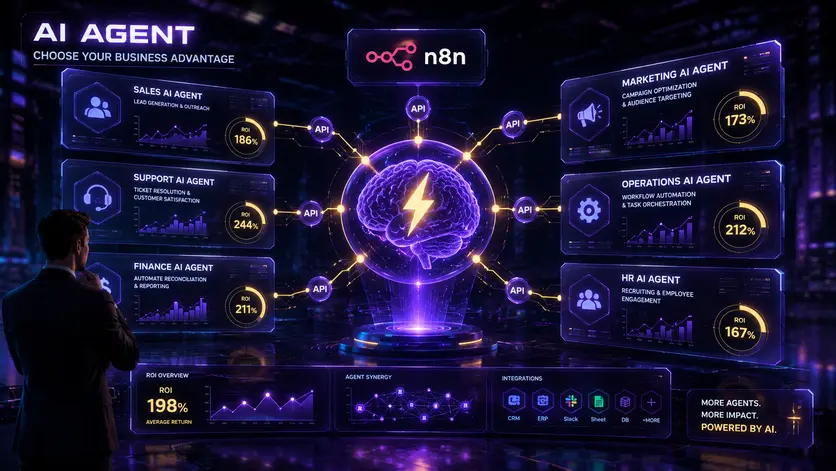
- Flexible Orchestration: The best solution for managing data flows is the use of professional orchestrators. We recommend building the architecture around the n8n platform, as it allows for the creation of extremely complex data exchange scenarios. Read more about .
2. Data Security: Cloud vs. Self-hosting
Security is a critical factor that is often forgotten. Your corporate data, financial reports, and client bases (CRM) are the main assets of the business.
- SaaS (Cloud Solutions): By using ready-made cloud platforms or mass products (like the standard ChatGPT by OpenAI), you transfer your data to foreign servers. This creates risks for companies working with sensitive information or under strict NDAs (medicine, finance, law).
- Self-hosted Solutions: Deploying AI infrastructure on your own servers is the gold standard of corporate security. Your knowledge bases and operational logic remain exclusively inside your company. The Datcor team specializes specifically in the development of secure Self-hosted systems.
3. Agent Specialization and RAG Technology
Another secret of how to choose an AI agent is avoiding ‘universal’ solutions that promise to do everything at once. The best results come from narrowly specialized agents connected to your internal data using RAG (Retrieval-Augmented Generation) technology. RAG allows the agent to find answers exclusively in your corporate documents, instructions, and price lists, completely eliminating the risk of ‘hallucinations’.
Depending on the ‘bottleneck’ in your business, choose the appropriate specialization:
- For processing incoming requests and support, AI agents for support and sales are ideal.
- If you lack new contacts in the B2B segment, focus on the and systems that .
- For structuring archives, analyzing contracts, and extracting data from invoices, you need AI agents for data processing and reliable document workflow automation.
4. Support for Agentic Workflows (Multi-agent Systems)
Business processes are rarely executed by one person; similarly, complex tasks should not fall on the shoulders of a single AI. Leading research from companies like Gartner confirms that the future lies in multi-agent systems.
When verifying how to choose an AI agent, ensure the platform allows creating Agentic Workflows. This is an architecture where several agents work in a team: for example, a Researcher Agent gathers information about a lead, a Strategist Agent forms a personalized proposal, and a Copywriter Agent writes the final email.
5. Independence from a Specific LLM (Agnostic Approach)
The neural network market is developing at a breakneck pace. Today one model leads; tomorrow another company releases a cheaper and faster alternative. Your AI agent must not be rigidly tied to a single provider. A correct architecture allows routing requests: complex analytical tasks are sent to expensive models, while simple text classification goes to fast and cheap (or even local open-source models like Llama 3).
6. Total Cost of Ownership (TCO) and Scalability Without Limits
Most popular no-code platforms (like Zapier or Make) sell subscriptions where you pay for every operation (task) performed. While you have 100 clients — it’s profitable. When there are 10,000 — the subscription cost becomes astronomical.
Choosing a solution based on your own servers and n8n, you pay only for direct requests to the language models’ APIs, which is hundreds of times cheaper, and the infrastructure itself works without limits on the number of operations. This makes automating routine tasks truly profitable.
7. Ability to Control (Human-in-the-Loop)
A reliable AI agent must have a ‘Human-in-the-Loop’ function. This means that during the first months of implementation or in critical situations (for example, approving a discount over 15%), the agent does not make the decision independently but forms a draft, which your manager approves or rejects with one click.
Automation Economics: How to Calculate Real ROI?
The process of deciding how to choose an AI agent should end with a clear financial calculation. Implementing AI agents for business automation is an investment. To determine the economics of automation, use this estimation formula:
- CapEx (Initial Capital Expenditures): These are one-time investments in consulting, architecture development, server deployment, creating a vector database (Vector DB), and setting up CRM integrations.
- OpEx (Operating Expenses): Monthly hosting fees and bills for token usage (LLM provider APIs). Usually, these sums are very small compared to the payroll fund.
- FTE Savings (Full-Time Equivalent): Calculate how many hours a day your employees spend on copy-pasting, searching for information, and answering typical questions. Convert these hours into the monetary equivalent of salaries. AI does not get sick, does not go on vacation, and works 24/7.
Common Mistakes When Choosing an AI Solution
- Automating Chaos: If your business processes are not regulated, AI will only accelerate the execution of incorrect actions. Before developing an agent, it is necessary to organize the company’s logic.
- Lack of Prepared Data: An agent works as well as the quality of data you give it. If your knowledge base consists of outdated Word documents with contradictory information — the agent will make mistakes.
- Expectations of Instant Magic: An AI agent is like a new employee. It needs time for adaptation, testing, prompt calibration, and knowledge base setup.
Conclusion
Understanding how to choose an AI agent is a strategic skill that will define market leaders in the coming years. Abandon cheap, template solutions that do not integrate with your business. Focus on creating your own secure, scalable infrastructure based on powerful orchestrators and multi-agent workflows.